Technology Assessment (TA) explores the relationship between science, technology and society. Is a concept which brings together researchers from different disciplines such as business economics, sociology or biology, to name a view. The common goal is to explore how current technological developments affect the world we live in.
More concretely, TA could for example make policy analysis about:
The projects database on this website gives a more encompassing picture of the issues dealt with in Technology Assessment at the EPTA member organisations.
Technology Assessment has three dimensions (Note 1):
And TA has three objects (Note 2):
TA has been defined in numerous ways. One definition, which fits Parliamentary Technology Assessment well (Note 2):
"Technology Assessment (TA) is a scientific, interactive and communicative process, which aims to contribute to the formation of public and political opinion on societal aspects of science and technology."
The EPTA organisations have a specific attribute by fully or partly having obligations towards parliaments. This means in practice that formal policy-making is part of the focus for the TA activities.
More about TA can be found here.
1: According to the EUROPTA project, established by EPTA members. "Participatory Technology Assessment" ISBN 0-85374-803-9
2: According to the TAMI project, on which EPTA members took part. "Technology Assessment - Methods and Impacts" ISBN: 3-540-21283-3
In this section you can download documents related to EPTA:
The EPTA network was formally established in 1990 under the patronage of the President of the European Parliament, Mr Enrique Baron Crespo. The network has a light structure, guided by the EPTA Council and by meetings of the Directors of the EPTA partner organisations.
The EPTA Council is the steering committee of the EPTA network, and consists of members of Parliament or representatives of the advisory boards for the respective EPTA organisation. The Council decides on organisational matters such as co-operation within the network and the status of members and associates.
The presidency of EPTA moves each year. The tasks of the EPTA member organisation holding the presidency are to coordinate the EPTA network activities and to host the annual EPTA Conference, Council Meeting and Directors' Meeting.
The members of the EPTA network are European organisations, which carry out TA studies on behalf of parliaments. Parliamentary TA is institutionalised in different ways, ranging from permanent parliamentary committees for TA; separate TA units as part of the parliamentary administration; to independent institutions with a mandate to serve as a permanent consulting institution for the parliament.
The following criteria for full membership are (Council decision Helsinki October 2001, amended in Vienna Octorber 2016) that the TA unit
is devoted to technology assessment (TA) or related activities,
serves the parliament,
has its own budget and secretariat,
has a competence regarding issues with a scientific and technological component, and
Associate membership can be granted to salient TA units, which have a TA programme and resources to realise it, but do not fully live up to the criteria 1, 4 or 5 for full membership. Associates are involved in all EPTA activities, but have no voting rights in the EPTA Council. Further, units interested in the work of EPTA can act as observers.
The decision to grant membership (both full and associate) is taken by the EPTA Council. Observer status is granted by the current EPTA presidency.
Members contribute financially to the EPTA meetings, common projects and the website & database.
EPTA can decide to make 'common EPTA projects', in which EPTA members and associates can join forces and make trans-European TA activities. EPTA projects are based upon the 'Joint EPTA Project Framework', which makes use of a bottom-up principle, according to which three or more members can initiate a project if it is open for active participation from other EPTA members. The project is decided during a Directors' meeting or Council Meeting after being scrutinised by the boards of the members. The outcome of an EPTA project is the sole responsibility of the participating members.
The presidency of EPTA moves each year. The tasks of the EPTA member organisation holding the presidency are to coordinate the EPTA network activities and to host the annual directors' meeting, EPTA conference, and council meeting.
In the year 2026, the presidency is held by Greece.
Contact
Prof Costas Papadimitriou (Παπαδημητρίου Δ. Κωνσταντίνος)
E-Mail: This email address is being protected from spambots. You need JavaScript enabled to view it.
European Parliamentary Technology Assessment (EPTA)
c/o current (2026) president, who are
Prof Costas Papadimitriou (Παπαδημητρίου Δ. Κωνσταντίνος)
E-Mail: This email address is being protected from spambots. You need JavaScript enabled to view it.
This website contains information about the activities of EPTA and its member institutions.
We do not accept responsibility for the content of pages to which we link from eptanetwork.org. However, we would be pleased, if you would inform us if you encounter a page to which we link that contains illegal content so that we can delete the link.
Originally: Solid-Systems EDV GmbH, Vienna
Now tended by IXSOL Innovative Solutions GmbH, Vienna
Institute of Technology Assessment (ITA), Vienna
This email address is being protected from spambots. You need JavaScript enabled to view it.
The EPTA partners advise parliaments on the possible social, economic and environmental impact of new sciences and technologies.
The common aim is to provide impartial and high quality accounts and reports of developments in issues such as for example bioethics and biotechnology, public health, environment and energy, ICTs, and R&D policy.
Such work is seen as an aid to the democratic control of scientific and technological innovations, and was pioneered in the 1970s by the Office of Technology Assessment (OTA) of the US Congress.
EPTA aims to advance the establishment of technology assessment as an integral part of policy consulting in parliamentary decision-making processes in Europe, and to strengthen the links between TA units in Europe.
If you want to be currently informed on EPTA and related TA activities, subscribe to the EPTA news feed
.
Additional information is available under:
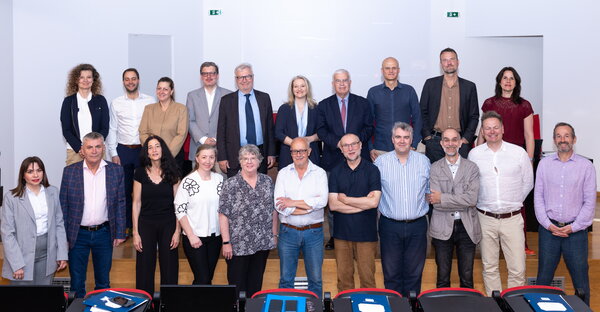
EPTA directors met in Thessaloniki

Photo: © GPCRT
Read more ...Greece holds the EPTA presidency in 2026.

Photo: © MN/ITA
Read more ...This year's EPTA report on the topic "Transformation of the energy mix" has been released

Source: MN/EPTA
Read more ...